The breakthrough is a wiring diagram.
On September 3, 2026, Google Research and collaborators announced the publication of a complete map of the adult male fruit fly’s central nervous system. The project, MaleCNS, spans the brain, optic lobes, and ventral nerve cord—the structure that helps connect sensory processing to movement.
The work brings together HHMI Janelia’s FlyEM team, the University of Cambridge, the MRC Laboratory of Molecular Biology, and Google Research. Researchers reconstructed neurons and their connections from electron-microscope images, with computational reconstruction and human proofreading. The accompanying Cell paper examines differences between male and female neural circuitry.
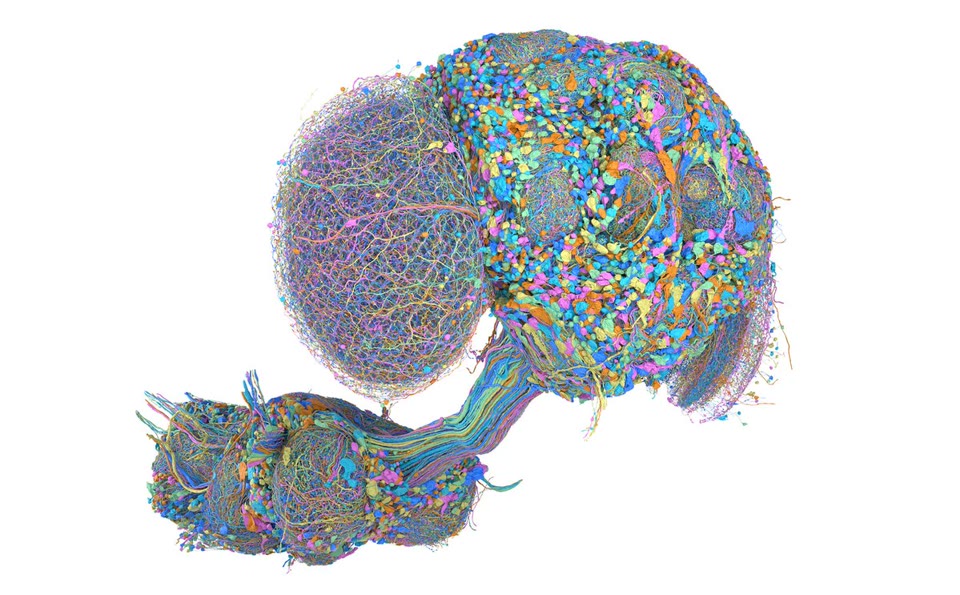
The official project page dates MaleCNS v1.0 to June 8, 2026. September 3 is the paper’s publication and publicity milestone. The September social-media wave was not the first availability of the v1.0 dataset.
This was part of a longer sequence of discoveries. FlyWire’s adult female brain map, published in 2024, contains 139,255 proofread neurons. It is a different specimen and dataset from MaleCNS. Some popular projects use FlyWire, some use MaleCNS, and others combine datasets or simulate only a small circuit.
How does a wiring map become a game controller?
A connectome is a map of which neurons connect to which other neurons. To make a program behave, a builder still has to choose rules for how signals travel, what the model receives, and how its output moves something on screen.
A major scientific predecessor is Shiu et al.’s 2024 computational brain model. It used a simplified “leaky integrate-and-fire” model: each neuron accumulates inputs, its state decays, and it emits a spike above a threshold. The study generated and experimentally tested predictions about feeding and grooming circuits.
For a body, builders may use flybody or NeuroMechFly / FlyGym. These supply physical bodies and environments. They are separate pieces from a connectome, and the brain-to-body connection still needs to be implemented.
Then the internet gave the fly a job.
The new publicity, downloadable data, existing simulation libraries, and rapid AI-assisted development made an unusually remixable combination. The following are dated source posts, not claims that each video demonstrates a validated ability.
The official dataset release, as recorded by the project.
The Cell publication, Google Research announcement, and Google’s widely shared post.
Evan Smith’s NeuroCraft Fly, Alex Wormuth’s Doomfly, and Jessica Paquette’s Fly64 turn the map into visibly interactive experiments.
lyra’s Beat Saber clip spreads widely. Flyhard documents steering experiments, and Stonkfly gives the simulated circuit a trading interface.
Nick Walton’s Rubik’s Cube video, social-network experiments, coding clips, and a language-model adapter broaden the theme.
FlyOCR parses glyphs. More creators explore instruments, desktop companions, art, and browser simulations.
Keep the wonder. Read the methods.
These projects can be interesting even when they do not reproduce natural fly behavior. A genuine anatomical graph does not make every attached sensor, learning rule, controller, or animation biological.
| Project | What the source actually says |
|---|---|
| Beat Saber fly | The creator describes a model overfit to one track, with replay data among its inputs. General play was still a goal. |
| Doomfly | The current candidate failed its validation gates. A running game and changing weights do not establish learned survival. |
| Stonkfly | The code supports paper trading and optional real execution. Profitable learning has not been demonstrated. |
| FLM | The language backbone supplies language ability. A small trained adapter reads the fixed fly graph. |
| NeuroCraft Fly | Footage and documentation are public. The playable mod and companion code are still being prepared. |
| Rubik’s Cube fly | A viral creator video. Reproducible code and an evaluation were not found in the reviewed sources. |
Counts also need context. Many projects retain about 166,700 neurons and 25.6 million directed neuron-pair edges. Multiple synaptic contacts can connect the same pair of neurons, so that edge count is not inconsistent with roughly 125 million contacts in the source reconstruction. Filtering and dataset versions also change counts.
“Dopamine” is a model input here. A numerical stimulus or artificial reward is not by itself evidence of pleasure, pain, consciousness, or a transplanted mind. The reviewed game and trading demonstrations do not establish those claims.
Choose the piece you want to explore.
- Inspect the wiring: start with MaleCNS, its downloads, or FlyWire’s Codex explorer.
- Understand a scientific model: read Shiu et al. before treating neural activity as behavior.
- Build an embodied experiment: inspect flybody and NeuroMechFly, then document the controller you connect to them.
- Make a small game: Fly Dino and Swat show how a circuit subset can become a focused interactive experiment.
Read each project’s license and data terms before reuse. Publicly readable code is not necessarily released under an open-source license, and the data can have different terms from the software.
Go to the original sources.
- MaleCNS official project and release historyDataset dates, collaboration, downloads, and license.
- Sexual dimorphism in the complete connectome of the Drosophila male central nervous systemCell · September 3, 2026.
- A connectomics milestone: Mapping the complete male fruit fly brainGoogle Research · September 3, 2026.
- FlyWire: the adult female brain connectomeOriginal project, consortium, and publication links.
- A Drosophila computational brain model reveals sensorimotor processingShiu et al. · Nature · October 2, 2024.
- The scientific publication accompanying flybodyDetailed physical embodiment and neural-control research.
About this collection.
Flymaxxing is an independent, manually curated snapshot of the fly-connectome scene, assembled by stainlu. We link original creator posts and repositories, prefer project documentation over reposted claims, and distinguish code, unreleased projects, research resources, and creator-only demonstrations.
The directory was reviewed on September 16, 2026. This is a source review, not an independent reproduction of every experiment. A listed demo may require its own setup, an account, compatible hardware, or a running backend. “Code available” means a public implementation was located, not that it was audited or independently validated.
Project screenshots and video stills are credited to their creators and linked to their sources. Some entries use typographic reference cards when a suitable preview was unavailable. Research discovery also benefited from Mert Cobanov’s Awesome Fly and Awesome Fruit Fly Connectome; individual entries were checked against primary project materials.
Bookmarks stay in your browser. The site has no account system or tracking scripts. You can inspect the directory data directly.
Back to the flies